If you have ever lost ten kilos and watched every gram crawl back over the following year, you already know the cruellest secret of weight loss: the problem was never your willpower. It was your biology. And for the first time, the science has caught up to that fact.
For decades, the advice was the same tired loop. Eat less. Move more. Try harder. Millions of Australians followed it to the letter, dropped the weight, and then watched their own bodies methodically undo every kilogram of progress. Not because they were weak. Because the human body is engineered to defend its fat stores like a vault.
Lose weight, and your metabolism quietly slows down. Your hunger hormones surge. The very act of dieting makes your body more efficient at storing fat and more desperate to eat. Researchers call it metabolic adaptation, and it is the reason an estimated 80% of people who lose significant weight regain most of it within five years.
This is the trap. And until very recently, there was no real way out of it, just a revolving door of diets that worked for a while and then failed in exactly the same way.
Then came the GLP-1 era. Ozempic. Wegovy. Mounjaro. For the first time, drugs could reach into that broken hunger system and turn the volume down. People lost weight and, crucially, kept it off while they stayed on treatment. It was a genuine breakthrough.
But it was only the first move. Those medicines pull one lever. The next generation pulls three.
Meet Retatrutide, the Triple Agonist
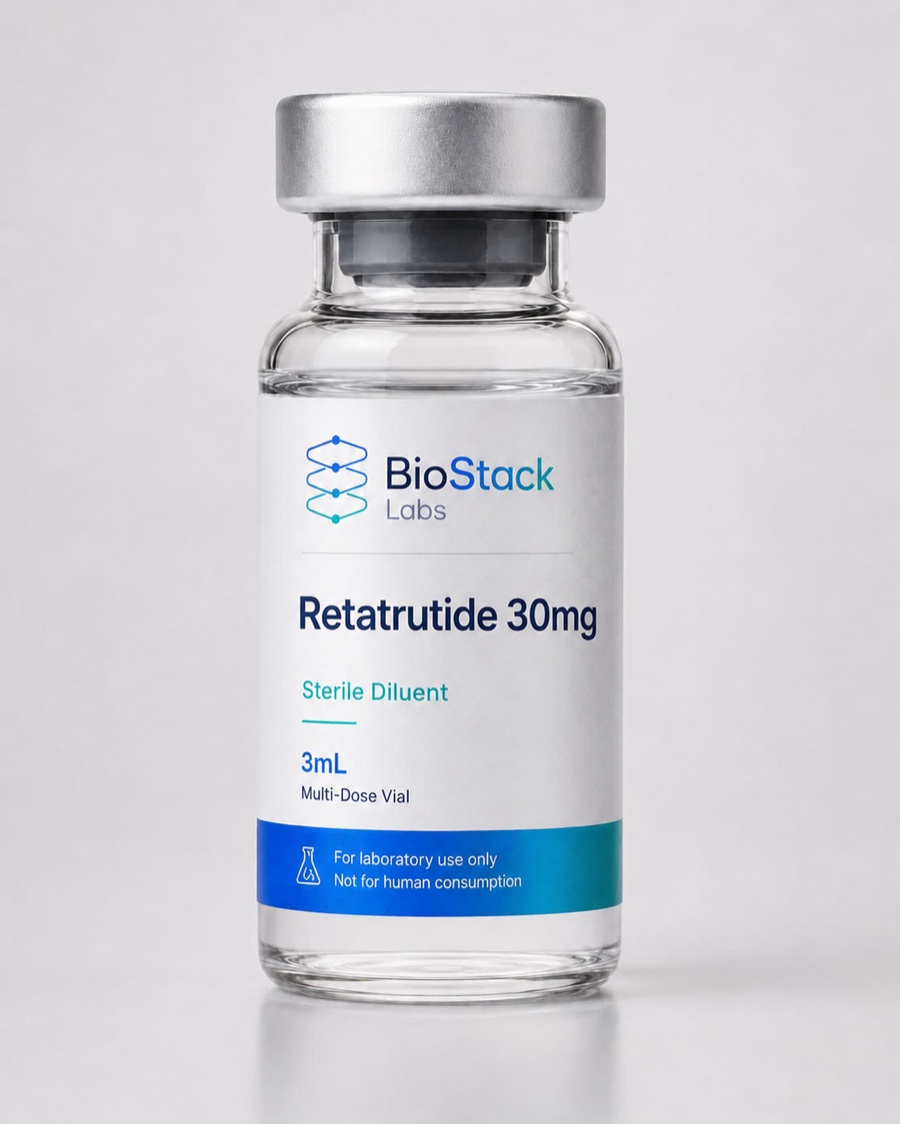
Retatrutide, currently known by the development code LY-3437943 and discussed in peptide circles by shorthand names tied to its dosing, is what scientists call a triple agonist. Where Ozempic activates one hormone receptor and Mounjaro activates two, Retatrutide activates three at once: GLP-1, GIP, and glucagon.
That third receptor, glucagon, is the difference that has the research world genuinely excited. GLP-1 and GIP help control appetite and blood sugar. But glucagon does something the others cannot: it tells the body to burn stored fat for energy and lift the metabolic rate. In other words, it does not just stop you eating. It turns your metabolism back up at exactly the moment a normal diet would be turning it down.
Most diets and most single-action drugs reduce how much you eat. Retatrutide reduces hunger and actively pushes the body to burn fat and works to keep your metabolism from crashing. It attacks the regain trap from three directions at once.
RT10, RT15, R-30: What the Code Names Actually Mean
If you have read anything about Retatrutide online, you have probably seen it referred to as RT10, RT15, RT30, or sometimes R-8 and R-12. These are not different products. They are shorthand for the dose, measured in milligrams. RT10 simply means a 10mg presentation. RT15 means 15mg. The numbers describe strength, nothing more.
This matters because Retatrutide is not a drug you start at full strength. In every clinical trial, participants began low and titrated up slowly over months, a process designed to let the body adjust and to keep side effects mild. The typical research schedule stepped through 2mg, then 4mg, then 8mg, climbing toward the higher 12mg range only for those who tolerated it well.
Understanding peptides themselves helps here. A peptide is simply a small string of amino acids, the same building blocks your body uses to make its own hormones. Retatrutide is engineered to closely mimic gut hormones that are released when you eat, which is why it can speak your metabolism's native language rather than overriding it with a foreign chemical.
The Numbers That Stopped Researchers in Their Tracks
Talk is cheap. The data is not. In the Phase 2 trial published in the New England Journal of Medicine, the results were so far beyond what anyone expected that several specialists publicly admitted they had never seen weight loss like it from a medicine.
To put 24% in context: the previous gold standard, semaglutide (Ozempic and Wegovy), produced roughly 15% average weight loss in its trials. Retatrutide did not edge past that number. It left it behind. And the trial had not even plateaued at 48 weeks, meaning participants were, on average, still losing weight when the study period ended.
"We have never seen this degree of weight loss from a medication in a trial of this length. It moves the entire field forward."
— Specialist commentary on the Phase 2 results, as reported in international medical pressHow Retatrutide Works on Three Fronts at Once
This is where it gets genuinely clever. Most weight-loss approaches do one thing. Retatrutide does three, and they reinforce each other.
Muscle is metabolically expensive tissue, it burns calories even at rest. Lose muscle on a crash diet and your metabolism drops, which is exactly why the weight comes roaring back. By protecting lean muscle while it strips fat, Retatrutide is designed to break that regain cycle at its root.
It Is Not Just the Scale. It Is Everything Downstream.
The weight loss is the headline, but the trial data showed something arguably more important: as the fat came off, the markers of metabolic health moved in the right direction across the board.
That last point gets overlooked, but it is real. When your appetite is genuinely under control, the impulse buys, the second coffees and pastries, the Friday takeaway, the constant grazing, they stop adding up on the receipt. For a lot of households, the change in the grocery bill is the first thing they notice.
Retatrutide vs Ozempic: An Honest Comparison
This is the question everyone asks, so let us be straight about it. Ozempic and Wegovy (both semaglutide) genuinely changed the game and remain TGA-approved, well-studied medicines. Retatrutide is newer, more powerful in the trial data, and still investigational. Here is how they actually compare.
The honest summary: Ozempic reduces how much you eat. Retatrutide reduces how much you eat, burns stored fat, and works to keep your metabolism and muscle intact while it does it. That is why the trial numbers are so far apart, and why the medical community is paying such close attention.
Why So Many Are Walking Away From Ozempic
Spend ten minutes in the online communities where people share their real experiences, and a pattern emerges. Ozempic works, but for a meaningful number of people the trade-offs wear thin over time. The complaints are remarkably consistent.
There is the much-discussed "Ozempic face", the gaunt, deflated look that comes from losing fat and muscle indiscriminately, including in the face. There is the muscle loss itself, which leaves people lighter but weaker. And there is the wall many hit, where the weight loss stalls around the 15% mark and simply stops.
"I lost weight on Ozempic but I looked sick and felt weak." It is one of the most common sentiments in patient forums, and it points straight at the problem Retatrutide was designed to solve: losing fat without sacrificing the muscle and metabolism that keep you healthy and strong.
None of this makes Ozempic a bad medicine. It is a good one. But it is a first-generation tool, and the people sharing these experiences are, in effect, describing the exact gaps that the triple-agonist approach set out to close.
The links above point to genuine published coverage and trial data so you can read the primary sources yourself, not a marketing summary.
Real People, Real Results
The testimonials below reflect the kinds of experiences people report on triple-agonist therapy. They are illustrative customer accounts, individual results vary, but they capture the pattern that comes up again and again.
Is It Safe? Here Is the Straight Answer.
Let us be honest rather than salesy, because you deserve that. In the trials, Retatrutide was generally well tolerated. The side effects were overwhelmingly the same mild, manageable ones seen across this whole class of medicines, and they tended to ease as the body adjusted.
The most common were gastrointestinal: nausea, some diarrhoea or constipation, and reduced appetite, especially in the first weeks and when stepping up a dose. This is precisely why the protocol starts low and climbs slowly. Rushing the dose is what causes problems; patience is what keeps it smooth.
You do not strictly need a fistful of tests to begin, but the people who do best treat it properly. Get your bloods done. Know your baseline. Start low, go slow, and check in. It is the difference between a smooth, sustainable result and an avoidable stumble, and it costs you almost nothing. Anyone managing an existing health condition or on other medications should speak with a doctor first, full stop.
It suits a wide range of adults, broadly the 18 to 70 bracket, and it does not care whether you have 10 kilos to lose or 40. What matters far more than your age is doing it the sensible way: a proper starting dose, a gradual climb, and ideally a quick set of baseline bloods so you know where you stand.
- A real conversation with our clinical team before anything begins
- Proper low-to-high titration schedule so you start safely
- Clinician-guided onboarding and baseline check-in
- Step-by-step guidance, no guesswork, no DIY dosing
- Discreet, temperature-controlled Australian delivery
Your Questions, Answered
Do I need to see my GP or get blood tests before starting?
You are not legally required to, but we strongly recommend a baseline blood panel, it is quick, inexpensive, and tells you exactly where you are starting from. The program includes a clinician-guided onboarding precisely so this is done properly. If you have an existing medical condition or take other medications, you should speak with your doctor before beginning. Doing it the smart way is doing it the safe way.
Is Retatrutide approved in Australia?
Retatrutide is currently investigational, it is in advanced clinical trials and is not yet TGA-approved as a finished consumer medicine. That is an honest and important distinction. Our program is structured around proper clinical guidance for exactly this reason. We will never tell you it is something it is not.
What are the actual side effects?
In trials the most common were gastrointestinal: nausea, mild diarrhoea or constipation, and reduced appetite, mostly in the early weeks and when increasing a dose. They were generally mild and eased with time. The slow titration schedule is specifically designed to minimise them. No medicine is risk-free, and we would never claim otherwise.
How is this different from Ozempic or Mounjaro?
Ozempic acts on one receptor, Mounjaro on two, and Retatrutide on three (GLP-1, GIP and glucagon). That third receptor actively burns stored fat and supports your metabolism, which is why the trial weight-loss numbers are roughly 24% versus around 15% for semaglutide, and why muscle retention is a built-in focus rather than an afterthought.
Will I lose muscle like people do on crash diets?
That is one of the core design goals. The GIP and glucagon activity is intended to help the body preferentially target fat while retaining lean muscle. Pairing the program with adequate protein and some resistance movement gives you the best possible result, but muscle protection is built into how the molecule works.
What does the 30-day guarantee cover?
If the program is not right for you within the first 30 days, contact our support team for a refund under our satisfaction guarantee. Full terms are provided at checkout.
The Window Is Open. The Choice Is Yours.
For the first time, the science has a real answer to the trap that has beaten dieters for generations. Not another round of eat-less-move-more, but a triple-action approach that burns fat, quiets hunger, and protects the muscle and metabolism that keep the weight off for good.
You can keep riding the lose-it, regain-it rollercoaster. Or you can do it the smart way, properly guided, sensibly dosed, with your baseline known, and finally get off the ride.
Talk to Our Health Team →Important Disclosure
This is a sponsored advertisement and editorial feature, not independent news reporting. The Australian Health Review may receive compensation when readers purchase through links on this page.
Retatrutide is an investigational compound undergoing clinical trials and is not currently approved by the TGA as a finished consumer medicine. The information here is general in nature and is not medical advice. It does not account for your personal health circumstances. Always consult a qualified healthcare professional before starting any new treatment, particularly if you have an existing medical condition, are pregnant or breastfeeding, or take other medications.
Testimonials are illustrative customer accounts. Individual results vary and are not guaranteed. Trial figures cited refer to published clinical study results and do not represent a promise of personal outcome. References: Jastreboff et al., New England Journal of Medicine (2023); Eli Lilly clinical data; Nature Medicine.